



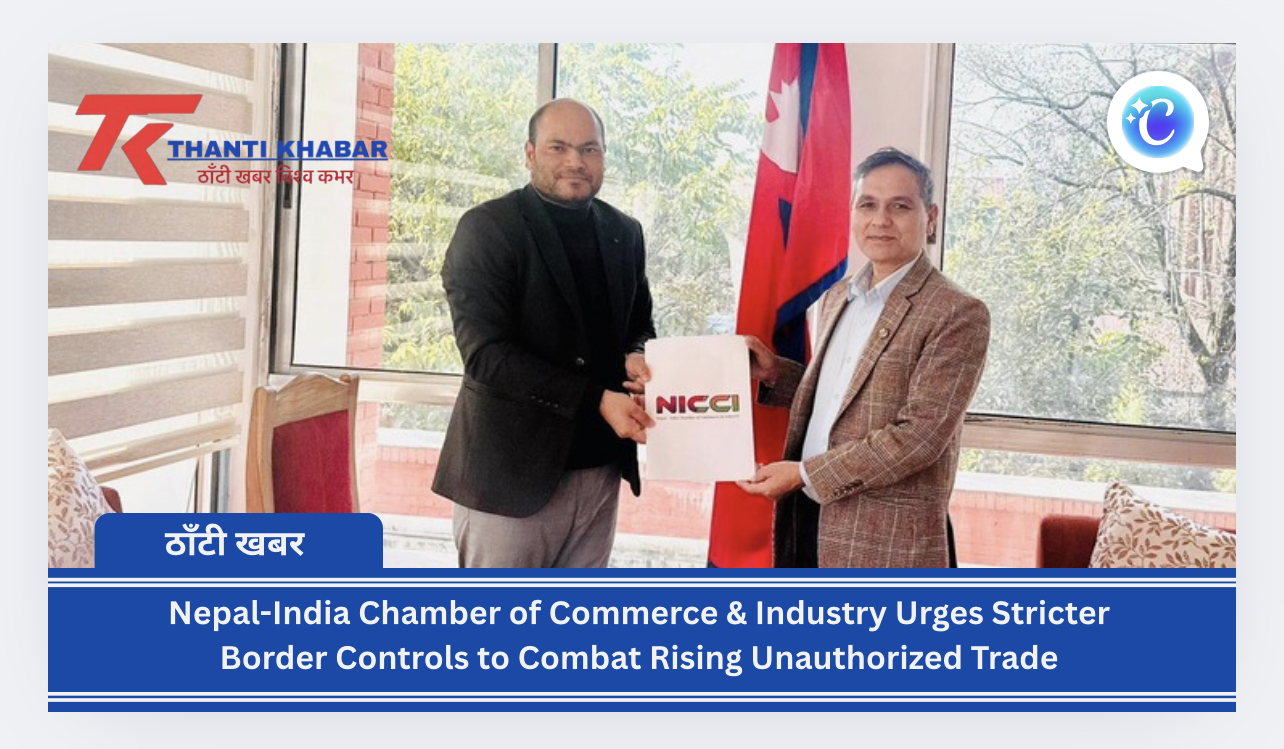
Nepal-India Chamber of Commerce & Industry Urges Stricter Border Controls to Combat Rising Unauthorized Trade
Kathmandu, November 30, 2025
The Nepal–India Chamber of Commerce & Industry (NICCI) has submitted a formal memorandum to Nepal’s Home Minister Om Prakash Aryal, urging immediate action to curb the growing issue of unauthorized trade flowing through the porous Nepal–India border. In light of recent changes to India’s GST policies, which have made Indian products significantly cheaper, NICCI warns that Nepal’s industries and businesses are being severely undermined.
Background: A Surge in Unauthorized Trade
In a bid to boost the competitiveness of domestically produced goods, the Indian government has slashed GST rates on numerous consumer products. This policy shift has driven down the Maximum Retail Price (MRP) of daily-use items and other goods produced in India, making them more affordable than their Nepali counterparts.
However, despite these favorable conditions for Indian products, the Government of Nepal has not adjusted customs duties, tax rates, or introduced any relief programs to alleviate the pressure on Nepali manufacturers. This has led to a significant price gap between Nepali and Indian goods, making it difficult for Nepali products to compete in the domestic market.
As a result, unauthorized trade through informal channels has surged. The unchecked flow of goods—bypassing the customs process and avoiding official taxes—has been a major blow to Nepali businesses, who now find themselves at a disadvantage due to unfair competition from cheaper imported goods.
NICCI’s Call for Action
NICCI’s President, Sunil K.C., presented a set of urgent recommendations to the Home Minister, emphasizing the need for stricter border controls to protect Nepal’s industrial sector and ensure the sustainability of legitimate trade.
In the memorandum, NICCI proposed the following actions:
-
Tighten Border Monitoring: Strengthen surveillance at the 22 key customs points along the Nepal–India border to prevent unauthorized imports.
-
Enhanced Coordination: Improve cooperation and coordination between Nepal Police, Armed Police Force, Customs, and other border-management agencies to ensure effective enforcement.
-
Targeted Monitoring: Focus special attention on goods whose prices have been directly impacted by the GST adjustments in India, to prevent under-invoicing and large-scale illegal trade.
-
Enforcement Drives: Launch targeted enforcement operations to control smuggling and other forms of illicit trade, particularly involving sensitive goods that could further destabilize Nepal’s market.
-
Regulate Informal Trade: Take administrative action to curb the misuse of the border between formal and informal trade, protecting legitimate businesses from unfair competition.
Government Response
In a promising development, Home Minister Om Prakash Aryal acknowledged the growing concerns and expressed his commitment to addressing the issue. He reassured NICCI that the Ministry of Home Affairs would take necessary and appropriate steps to implement these recommendations and ensure that unauthorized trade does not undermine Nepal’s economy.
NICCI’s efforts come at a critical time, as the rise in informal trade could have long-term consequences on the country’s industrial sector and the livelihoods of countless workers in Nepali businesses.
“The success of Nepal’s economy depends on a thriving, competitive industrial sector. The government must act swiftly to address this rising issue, ensuring that legitimate businesses are not left to suffer due to unfair trade practices,” said Sunil K.C., President of NICCI.
With the government showing signs of cooperation, it is hoped that these recommendations will soon be put into action to restore balance to Nepal’s market and protect the future of Nepali industries.
- ‘Xtrim’ ड्रिंकको अस्वाभाविक विज्ञापनप्रति संसद्मा हर्क साम्पाङको आपत्ति, सरकारको ध्यानाकर्षण
- श्रम र श्रमदानमा समर्पित गोरखा बोर्लाङका मनोहर ढकाल : कामबाट पहिचान बनाउने हर्कवादी
- पूर्वाग्रह र नकारात्मकता छोडेर निष्पक्ष रूपमा चलचित्र हेर्न उद्योगपति मल्होत्राको आग्रह; प्रियंका कार्कीको अभिनय र साहसको उच्च प्रशंसा
- विकासप्रेमी युवा उद्यमी निर्मल पाठक रत्ननगरको समृद्धिको अभियानमा
- आजको मौसम समाचार : देशका अधिकांश भू–भागमा वर्षाको सम्भावना
- विदेश पठाइदिने भन्दै १७ लाख ठगी! मलेसिया र अमेरिका पठाउने प्रलोभनमा २ जना पक्राउ
- कुवेतमा घरेलु कामदार पठाउने भन्दै ९ महिलालाई झुक्याएको आरोप, एक महिला पक्राउ
- १८ वर्षीया किशोरीलाई जबरजस्ती करणी गरेको आरोपमा ४० वर्षीय पुरुष पक्राउ
- चोरी मुद्दाका फरार प्रतिवादी पक्राउ, १ वर्ष १० महिना कैद र ३० हजार जरिवाना
- आजको राशिफल — २०८३ भदौ ७ गते, आइतबार


- ‘Xtrim’ ड्रिंकको अस्वाभाविक विज्ञापनप्रति संसद्मा हर्क साम्पाङको आपत्ति, सरकारको ध्यानाकर्षण
- श्रम र श्रमदानमा समर्पित गोरखा बोर्लाङका मनोहर ढकाल : कामबाट पहिचान बनाउने हर्कवादी
- पूर्वाग्रह र नकारात्मकता छोडेर निष्पक्ष रूपमा चलचित्र हेर्न उद्योगपति मल्होत्राको आग्रह; प्रियंका कार्कीको अभिनय र साहसको उच्च प्रशंसा
- विकासप्रेमी युवा उद्यमी निर्मल पाठक रत्ननगरको समृद्धिको अभियानमा
- आजको मौसम समाचार : देशका अधिकांश भू–भागमा वर्षाको सम्भावना
- विदेश पठाइदिने भन्दै १७ लाख ठगी! मलेसिया र अमेरिका पठाउने प्रलोभनमा २ जना पक्राउ
- कुवेतमा घरेलु कामदार पठाउने भन्दै ९ महिलालाई झुक्याएको आरोप, एक महिला पक्राउ
- १८ वर्षीया किशोरीलाई जबरजस्ती करणी गरेको आरोपमा ४० वर्षीय पुरुष पक्राउ
- चोरी मुद्दाका फरार प्रतिवादी पक्राउ, १ वर्ष १० महिना कैद र ३० हजार जरिवाना
- आजको राशिफल — २०८३ भदौ ७ गते, आइतबार



प्रतिकृया दिनुहोस्